






For many enterprises, the biggest warehouse problem is not a lack of inventory data. It is the inability to know what is actually happening right now.
Inventory may exist in the system, but teams still spend hours checking spreadsheets, calling warehouse staff, reconciling ERP records, or physically searching for products. By the time an inventory discrepancy is discovered, the business may already be facing stockouts, overstocking, delayed fulfillment, or customer complaints.
This is where a modern warehouse management system (WMS) becomes strategically important.
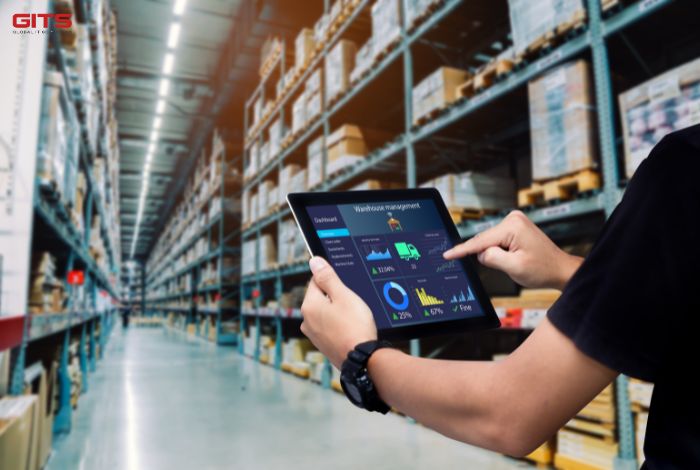
A WMS does more than record inventory transactions. It connects warehouse activities, inventory movements, orders, locations, and operational data into a unified environment, giving enterprises real-time visibility and greater control over their supply chain. SAP describes WMS as a core supply chain technology that provides visibility into inventory both inside warehouses and in transit.
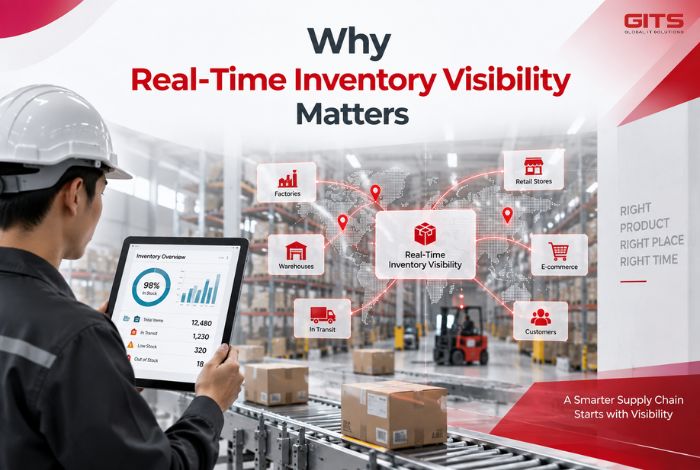
Why Real-Time Inventory Visibility Matters
Traditional inventory management often depends on periodic updates. Stock information may be technically available, but it can quickly become outdated as goods are received, moved, picked, returned, or shipped.
This creates a critical gap between system inventory and physical inventory.
For enterprises operating multiple warehouses, distribution centers, retail locations, or e-commerce channels, this gap becomes even more costly. A product shown as available may already be allocated to another order. A shipment may have left one facility but not yet been reflected across connected systems.
A modern warehouse management system closes this visibility gap by capturing warehouse transactions as they occur.
Barcode scanners, mobile devices, RFID, ERP integrations, order management systems, and warehouse workflows can feed data into a centralized WMS environment. Gartner notes that modern WMS platforms use mobile devices, barcodes, RFID, and scanning technologies to create accurate information in near real time.
The result is a more reliable operational picture: what inventory exists, where it is located, what is available, what is reserved, and what is moving.
How a Warehouse Management System Creates Real-Time Visibility
Real-time visibility is not simply about displaying inventory numbers on a dashboard. It requires the warehouse management system to continuously capture and synchronize operational events.
1. Accurate Inventory at Location Level
A modern WMS can track inventory beyond the warehouse level and down to zones, racks, shelves, bins, lots, batches, or serial numbers.
When an item moves, the system updates its location and status. This enables warehouse teams and managers to identify not only how much inventory is available, but also where it is and what condition it is in.
This level of granularity is particularly valuable for manufacturers, retailers, healthcare organizations, food businesses, and enterprises managing products with expiration or traceability requirements.
2. Connected Warehouse Operations
Receiving, put-away, picking, packing, shipping, replenishment, and returns are interconnected processes.
If these activities operate in isolated systems, inventory visibility becomes fragmented.
A warehouse management system connects these processes so that each transaction contributes to a single operational view. Modern WMS platforms can also integrate with ERP, SCM, order management, e-commerce, and automation systems, allowing inventory information to move across the broader enterprise.
3. Real-Time Alerts Instead of Manual Reconciliation
Visibility becomes more valuable when the system can identify exceptions automatically.
For example, a WMS can detect:
• Inventory quantity mismatches
• Unexpected stock movements
• Low-stock conditions
• Wrong-bin putaway
• Picking discrepancies
• Expiry risks
• Delayed warehouse processes
Instead of waiting for a monthly inventory check, operations teams can respond while the issue is still manageable.
From WMS to AI-Powered Warehouse Management
The next evolution of warehouse management is moving beyond visibility toward intelligence.
A conventional WMS primarily records and coordinates what is happening. AI-powered warehouse management can analyze those events, identify patterns, predict potential problems, and recommend actions.
AI can analyze historical inventory movements, order patterns, warehouse capacity, workforce utilization, picking performance, and operational anomalies. This enables organizations to move from reactive management toward predictive decision-making. Infor, for example, highlights how AI can translate warehouse data into real-time guidance and identify issues before they become operational problems.
This is where AI Agents and Agentic AI can add another layer of value.
Instead of simply presenting an alert such as “SKU A is below the threshold,” an AI Agent can analyze demand, current inventory, open orders, supplier lead times, and warehouse capacity to determine whether replenishment is actually necessary.
The AI Agent can then recommend the next action, trigger an approved workflow, or escalate the issue to the appropriate team.
The WMS therefore becomes more than a system of record. It becomes part of an AI-driven operational decision layer.
What Enterprises Gain from Real-Time WMS Visibility
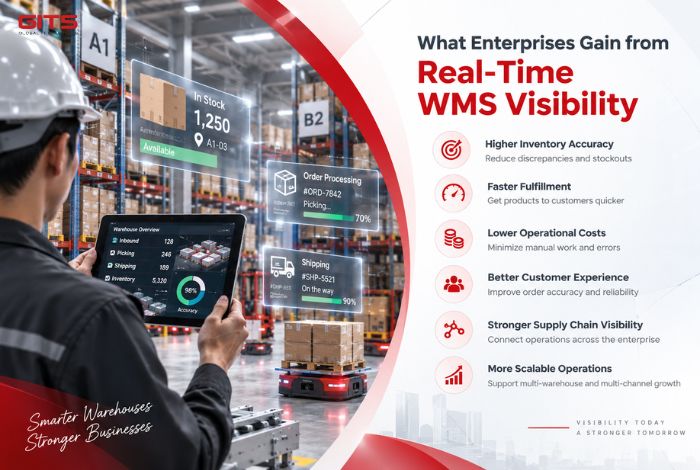
For businesses operating complex supply chains, the value extends beyond inventory accuracy.
A connected warehouse management system can help enterprises achieve:
– Higher inventory accuracy: Reduce discrepancies between physical stock and system records.
– Faster fulfillment: Give warehouse teams accurate information about product availability and location.
– Lower operational costs: Reduce unnecessary manual checking, reconciliation, and searching.
– Better customer experience: Improve order accuracy and fulfillment reliability.
– Stronger supply chain visibility: Connect warehouse information with broader ERP, SCM, transportation, and commerce operations.
– More scalable operations: Support multi-warehouse and multi-channel operations without relying entirely on manual coordination.
For Japan and Korea in particular, where operational precision, process standardization, traceability, and workforce efficiency are critical, this shift can be highly valuable. For global and Vietnamese enterprises, real-time visibility also provides a foundation for scaling e-commerce, omnichannel fulfillment, manufacturing, and 3PL operations.
>>> See More: AI Agents in Logistics: From Automation to Autonomous Systems
Building a Smarter Warehouse with AI and WMS
Implementing a WMS should not be viewed simply as replacing spreadsheets with another software platform.
The greater opportunity is to establish a connected technology architecture where WMS + ERP + IoT + automation + AI Agents work together.
The WMS provides trusted operational data.
IoT, barcode, RFID, and mobile devices provide real-time signals.
AI analyzes those signals and identifies patterns.
AI Agents can then transform insights into recommended or automated actions.
This architecture creates a continuous operational loop:
Sense → Understand → Decide → Act → Learn
That is the foundation of the transition from traditional warehouse management to an AI-powered smart warehouse.
Real-Time Visibility Is the Foundation of Intelligent Warehousing
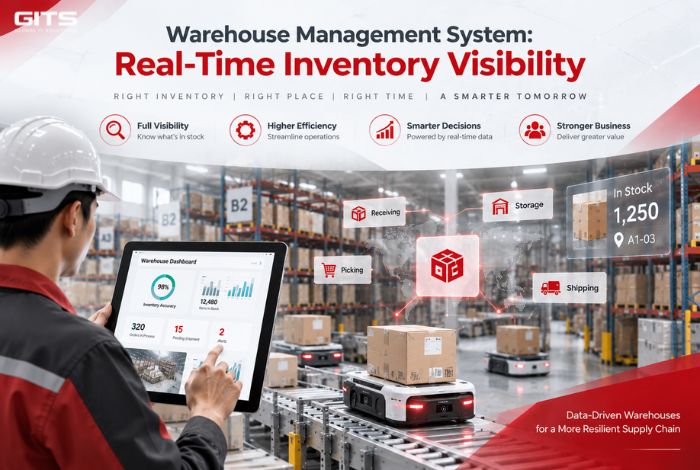
A warehouse management system is no longer simply a tool for tracking stock.
For modern enterprises, it is becoming a critical layer for achieving real-time inventory visibility, operational control, and intelligent supply chain execution.
When WMS data is connected with ERP, automation, IoT, and AI Agents, enterprises can move beyond asking “How much inventory do we have?” to more strategic questions:
Where is it? What is happening to it? What will happen next? And what should we do now?
That shift—from inventory visibility to intelligent action—is what makes the next generation of warehouse management truly transformative.
For enterprises looking to modernize warehouse operations, improve inventory accuracy, and build an AI-ready supply chain, the right WMS is not simply a software investment. It is the foundation for the next stage of AX and intelligent enterprise transformation.