





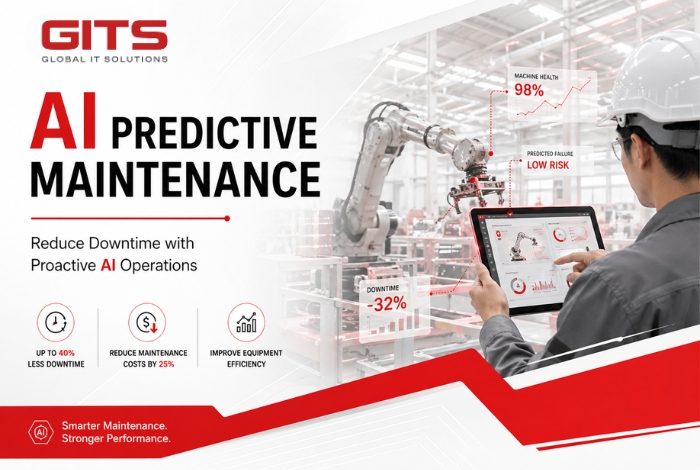
Unplanned downtime is one of the most critical challenges in manufacturing today. A single hour of production disruption can cost thousands – millions – of dollars, especially in high-precision industries such as automotive, electronics, and semiconductor manufacturing.
Despite the adoption of predictive maintenance systems, many factories still struggle to prevent failures in time. Traditional approaches rely heavily on sensor data, which often only detects issues when they are already imminent.
This is where AI predictive maintenance is redefining the landscape. Instead of simply detecting failures, it enables businesses to predict, prevent, and act proactively—transforming maintenance into a strategic advantage.
What is AI Predictive Maintenance?
AI predictive maintenance is an advanced approach that uses artificial intelligence, machine learning, and operational data to predict equipment failures before they occur.
Unlike traditional maintenance systems that depend solely on sensor thresholds, AI-driven solutions analyze a broader ecosystem of data, including production workflows, historical maintenance records, and system behavior patterns over time.
This shift allows manufacturers not only to detect anomalies but also to understand the root causes and predict future risks with significantly higher accuracy.
Why traditional predictive maintenance is no longer enough
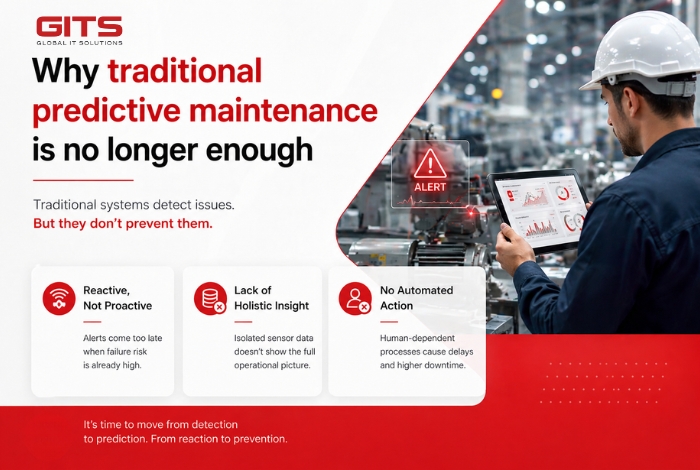
Sensor-based systems are reactive, not proactive
Most traditional predictive maintenance systems are built around IoT sensors. While these sensors provide valuable real-time data, they lack the ability to interpret complex operational contexts.
As a result, alerts are often triggered too late—when equipment is already close to failure. This reactive nature limits the effectiveness of maintenance strategies.
Lack of system-wide intelligence
Manufacturing environments are highly interconnected. A failure in one machine can impact the entire production line. However, sensor-based systems typically operate in silos, without integrating data from ERP, MES, or supply chain systems.
This lack of holistic visibility prevents organizations from making informed, proactive decisions.
No automated execution
Even when issues are detected, most systems still rely on human intervention to initiate maintenance actions. This delay increases the risk of downtime and reduces operational efficiency.
How AI Predictive Maintenance reduces downtime
From data integration to intelligent insights
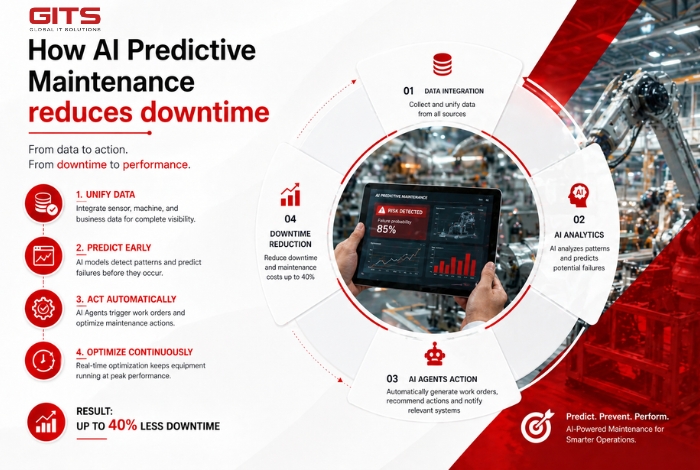
AI predictive maintenance begins by integrating multiple data sources into a unified platform. This includes IoT sensor data, production data from MES systems, business data from ERP platforms, and historical maintenance logs.
By combining these datasets, AI can create a comprehensive understanding of how equipment behaves under different conditions. This holistic view is essential for accurate predictions.
Predicting failures before they happen
Machine learning models analyze historical and real-time data to identify hidden patterns and early warning signals. These models continuously learn and improve, enabling them to predict failures days or even weeks in advance.
According to industry studies, AI-driven predictive maintenance can reduce equipment downtime by 20% to 40% and lower maintenance costs by up to 25%.
AI Agents enabling autonomous operations
One of the most transformative aspects of AI predictive maintenance is the use of AI Agents. These intelligent systems do not just provide insights—they take action.
AI Agents can automatically generate work orders, recommend optimal maintenance strategies, and trigger workflows across enterprise systems. This reduces dependency on manual decision-making and ensures faster response times.
>>> See More: The future of enterprise operations is Human AI collaboration
Real-time optimization of operations
Beyond predicting failures, AI systems continuously optimize machine performance in real time. They can adjust operating parameters, recommend scheduling changes, and prevent inefficiencies before they escalate into critical issues.
This capability is a cornerstone of modern Smart Factory initiatives.
Real-world use cases in manufacturing
Automotive industry
A Japanese automotive manufacturer implemented AI predictive maintenance across its production lines and reduced unexpected machine failures by 32% within six months. This improvement significantly enhanced production stability and reduced operational risks.
Electronics manufacturing
In high-precision electronics production, even minor equipment issues can lead to defects. AI-driven maintenance systems help detect micro-level anomalies, ensuring product quality and minimizing waste.
Heavy industry and energy
In sectors such as energy and heavy machinery, predictive maintenance plays a critical role in preventing large-scale failures. AI systems can monitor turbines, generators, and industrial equipment, ensuring continuous and stable operations.
Strategic benefits for enterprises
Significant reduction in downtime
By predicting and preventing failures, manufacturers can maintain continuous operations and avoid costly disruptions. This is especially important in industries where uptime directly impacts revenue.
Improved cost efficiency
AI predictive maintenance reduces the need for emergency repairs and optimizes maintenance schedules. This leads to better resource allocation and extends the lifespan of critical assets.
Enhanced operational resilience
With AI-driven insights and automation, enterprises can respond more effectively to unexpected changes. This improves overall resilience and ensures long-term competitiveness.
Key considerations for implementation
Data readiness is the foundation
Successful implementation requires clean, standardized, and integrated data. Organizations must break down data silos and ensure seamless connectivity between systems.
Choosing the right AI platform
Enterprises should select scalable AI platforms that support advanced analytics and AI Agents. Flexibility and integration capabilities are critical for long-term success.
Leveraging Vietnam IT Outsourcing
For companies in Japan and South Korea, partnering with Vietnam IT Outsourcing providers offers a strategic advantage. These partnerships provide access to highly skilled engineers, cost-effective solutions, and faster deployment timelines.
Japan and Korea market insights: What enterprises really need
Japanese enterprises prioritize system reliability, long-term stability, and precise operational control. They require solutions that are robust, predictable, and aligned with strict quality standards.
In contrast, Korean companies focus on speed, scalability, and rapid innovation. They are more open to adopting cutting-edge AI technologies to gain competitive advantages quickly.
Understanding these differences is essential for delivering successful AI predictive maintenance solutions in both markets.
The future: From predictive maintenance to autonomous operations
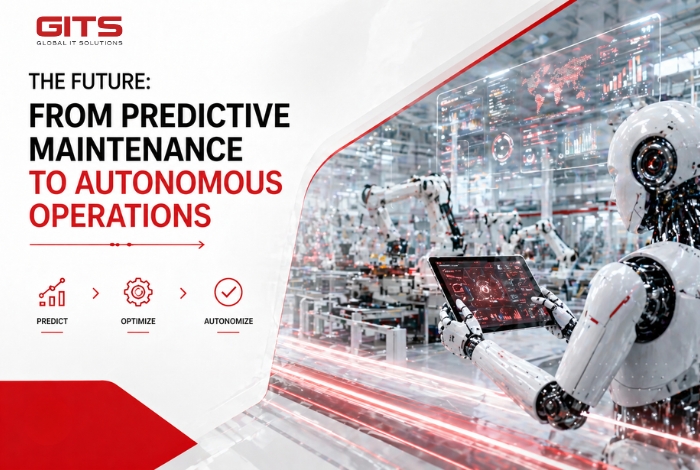
AI predictive maintenance is only the beginning of a broader transformation. The next stage is autonomous operations, where systems can self-optimize and make decisions without human intervention.
With the integration of Digital Twin technologies and advanced AI models, factories will evolve into fully intelligent ecosystems capable of continuous self-improvement.
This evolution is a key pillar of AX (AI Transformation) strategies across industries.
Unlocking the full potential of AI Predictive Maintenance
AI predictive maintenance is no longer a “nice-to-have” technology—it is a critical capability for modern manufacturing. By moving from reactive detection to proactive prediction and action, enterprises can significantly reduce downtime, optimize costs, and enhance operational performance.
For organizations in Japan and South Korea, combining AI predictive maintenance with AI Agents and strategic partnerships in Vietnam IT Outsourcing provides a powerful pathway to accelerate AX initiatives.
The future of manufacturing belongs to those who can predict, adapt, and act in real time. AI is not just supporting operations—it is redefining them.