








MES Dispatching and WIP visibility play a critical role in reducing production delays across modern manufacturing environments. By enabling real-time job scheduling and shop-floor monitoring, MES systems help manufacturers improve production flow, minimize bottlenecks, and increase operational efficiency—without adding headcount.
MES Dispatching & WIP Visibility: A Practical Playbook to Reduce Production Delays Without Adding Headcount
In modern manufacturing environments, production delays are often addressed by adding manpower or extending operating hours. While these measures may temporarily increase output, they rarely solve the operational inefficiencies that cause delays in the first place.
In many factories, the real problem lies in inefficient job dispatching and limited visibility into Work-In-Progress (WIP) across the production floor. When production planning and shop-floor execution are not synchronized, manufacturers frequently encounter idle machines, delayed orders, and production bottlenecks.
A Manufacturing Execution System (MES) equipped with real-time dispatching and WIP visibility capabilities helps manufacturers address these challenges without increasing headcount. By improving scheduling logic and enabling real-time production monitoring, MES allows factories to operate more efficiently while supporting broader smart manufacturing and Industry 4.0 initiatives.
This article provides a practical playbook for reducing production delays through MES dispatching, enhanced WIP visibility, and strategic IT outsourcing partnerships.
Understanding the Symptoms of Production Delays
Before improving production scheduling, manufacturers must first recognize the operational symptoms that indicate inefficiencies within the production process.
Idle operators and machines
One of the most common indicators of poor scheduling is the presence of idle operators or machines while pending work orders still exist. This situation often occurs when tasks are distributed manually or when production supervisors rely on static schedules that fail to reflect real-time shop-floor conditions.
Bottlenecks between workstations
Another frequent issue is the accumulation of materials between production stages. When upstream processes operate faster than downstream ones, work-in-progress begins to pile up, creating bottlenecks that slow down overall production throughput.
Inconsistent job sequencing
Production schedules can also be disrupted when tasks are processed in the wrong order. High-priority orders may be delayed if jobs are executed based on operator preference rather than system-defined priority rules.
Limited WIP visibility
Without clear visibility into WIP status, production managers struggle to determine where delays occur or which workstations are creating congestion. This lack of transparency often leads to reactive decision-making instead of proactive production optimization.
Root Causes of Inefficient Production Scheduling
Although these symptoms appear operational, their root causes typically originate from gaps between production planning systems and shop-floor execution.
Static production planning
Many factories still depend heavily on ERP-generated production schedules. While ERP systems are effective for high-level planning, they typically produce static schedules that cannot adapt to real-time production changes.
Lack of real-time shop-floor data
Production environments constantly change due to factors such as machine downtime, material availability issues, operator capacity variations, and quality inspection results. Without real-time data integration, production schedules quickly become outdated.
Manual dispatching
In many factories, supervisors manually assign tasks based on experience or informal communication. While this approach may work in smaller operations, it becomes inefficient as production complexity increases.
How MES Dispatching Improves Real-Time Production Control
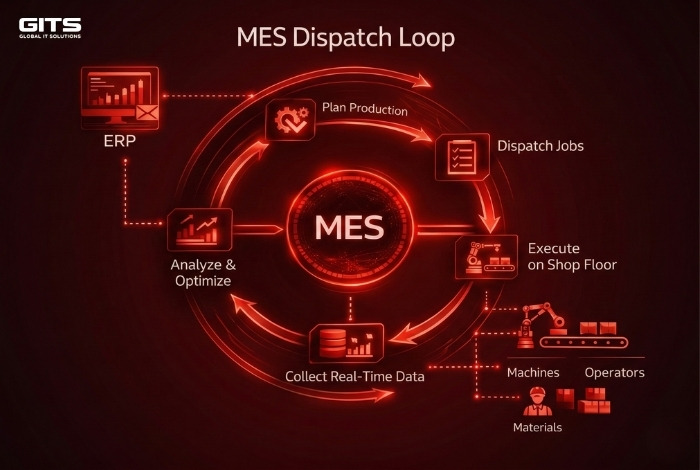
MES dispatching bridges the gap between production planning and shop-floor execution by dynamically assigning tasks based on real-time operational data.
Instead of relying on static production plans, MES systems continuously evaluate shop-floor conditions and allocate tasks accordingly. Key capabilities typically include:
- Real-time job dispatching
- Dynamic job prioritization
- Machine availability monitoring
- Operator allocation management
- Production workflow coordination
Through these capabilities, manufacturers can ensure that the right job is executed at the right workstation at the right time. This significantly improves scheduling accuracy while reducing idle time across the production line.
Dispatching Rules That Optimize Production Scheduling
Effective MES dispatching relies on predefined scheduling rules that determine how tasks are assigned and sequenced.
Priority-based scheduling
Jobs are executed based on predefined priority levels. Urgent orders or time-sensitive tasks can therefore be completed first.
Minimum waiting time
This rule prioritizes jobs that have been waiting the longest in the production queue, helping reduce delays and maintain production flow.
Machine capability matching
Certain machines may have specialized capabilities required for specific production processes. MES ensures tasks are assigned to the most suitable equipment.
Capacity balancing
When multiple machines can perform the same operation, MES distributes tasks evenly to prevent localized bottlenecks.
Together, these rules help maintain stable production flow even when disruptions occur.
Building a WIP Visibility Model for Smart Manufacturing
Efficient dispatching requires full visibility into work-in-progress across the entire production lifecycle.
A structured WIP visibility model enables manufacturers to track production status and identify bottlenecks quickly.
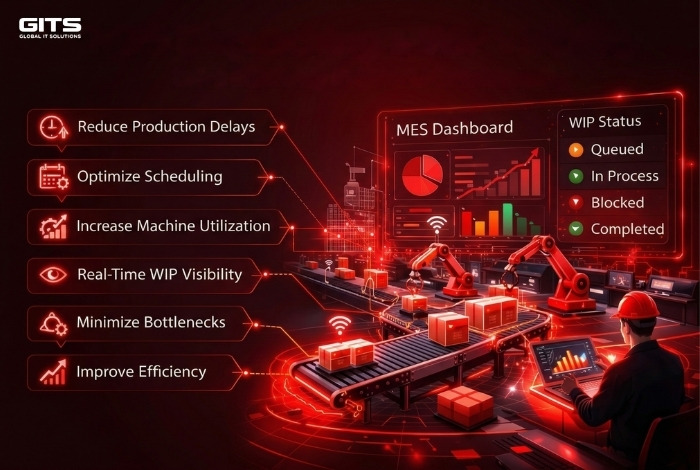
WIP status categories
Typical WIP tracking models include several key statuses:
- Queued – Materials waiting for processing
- In Process – Production activities currently underway
- Blocked – Work completed but unable to proceed due to downstream constraints
- Completed – Processing successfully finished at the workstation
Monitoring WIP aging
Another important metric is WIP aging, which measures how long materials remain within a specific production stage. Excessive WIP aging often indicates process imbalance or insufficient production capacity.
By monitoring WIP aging, manufacturers can proactively address bottlenecks before they disrupt the entire production line.
Phased Rollout Strategy for MES Implementation
Implementing MES dispatching should be approached gradually to minimize operational disruption.
Phase 1 – Production visibility
The first phase focuses on establishing visibility across the production line. Manufacturers begin by tracking machine status, operator assignments, WIP locations, and overall production progress.
This step provides the foundation for data-driven production control.
Phase 2 – Controlled dispatching
Once visibility is established, automated dispatching rules can be introduced for selected production lines. The objective is to improve job sequencing and reduce idle machine time.
Phase 3 – Optimization and scaling
In the final phase, manufacturers refine scheduling strategies using production data and analytics. Advanced MES deployments may incorporate predictive scheduling, automated bottleneck detection, and AI-driven production optimization.
These capabilities enable factories to continuously improve operational performance.
Measuring Production Performance with Key KPIs
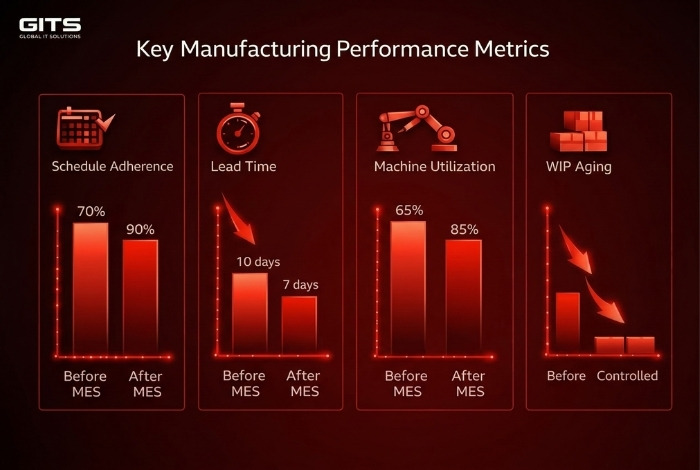
To evaluate the effectiveness of MES dispatching, manufacturers should track performance indicators before and after implementation.
Important KPIs include:
-
Schedule adherence – alignment between planned and executed production schedules
-
Lead time – total time required for a product to complete the production cycle
-
Machine utilization – percentage of time machines are actively producing
-
WIP aging – duration materials remain idle between production stages
Many MES deployments demonstrate measurable improvements in these metrics.
For example:
| KPI | Before MES | After MES |
|---|---|---|
| Schedule adherence | 70% | 90% |
| Lead time | 10 days | 7 days |
| Machine utilization | 65% | 85% |
| WIP aging | High | Controlled |
These improvements are primarily driven by better scheduling coordination and improved shop-floor visibility rather than increased labor resources.