






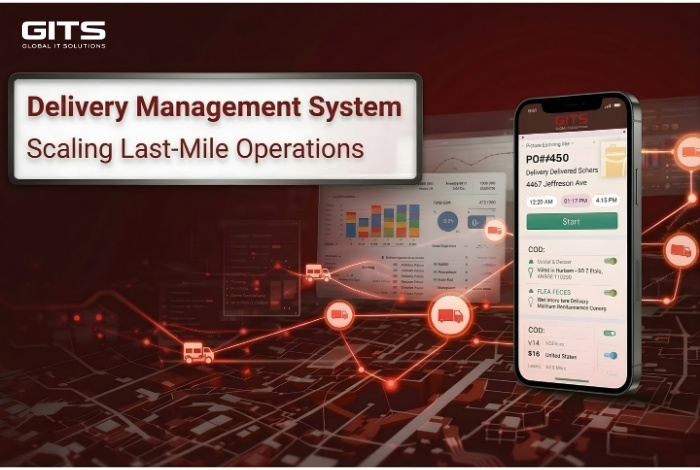
As logistics networks expand and customer expectations for faster delivery increase, enterprises face growing pressure to optimize last-mile operations. A modern Delivery Management System becomes essential to streamline dispatching, improve visibility, and reduce operational inefficiencies. In this case study, GITS implemented an automated, cloud-based solution for a logistics provider to scale delivery operations while maintaining service quality and cost control.
Customer Background
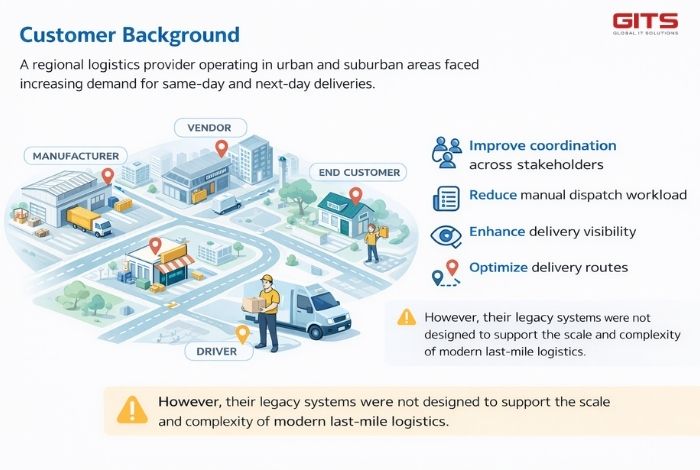
The customer is a regional logistics service provider operating across multiple urban and suburban areas. Their business model relies on coordinating deliveries between manufacturers, vendors, drivers, and end customers.
With increasing demand for same-day and next-day delivery services, the company aimed to:
– Improve delivery coordination across multiple stakeholders
– Reduce manual workload in dispatching operations
– Enhance visibility into delivery status and performance
– Optimize delivery routes and resource allocation
However, their legacy systems were not designed to support the scale and complexity of modern last-mile logistics.
Technical Challenges
The customer faced several operational and system-level challenges that directly impacted delivery efficiency and customer satisfaction.
Fragmented Dispatching Process
Dispatching tasks were handled manually or semi-manually, leading to:
– Inefficient assignment of delivery tasks
– Delays in route planning
– High dependency on human operators
Limited Real-Time Visibility
The existing system lacked real-time tracking capabilities, making it difficult to:
– Monitor driver activities
– Track delivery progress
– Provide accurate updates to customers
Inefficient Route Planning
Without intelligent route optimization:
– Drivers often followed suboptimal routes
– Fuel costs increased
– Delivery times became inconsistent
Lack of Integration
The system operated in silos, with limited integration between:
Vendor management systems
Driver applications
Customer-facing portals
This fragmentation reduced operational transparency and slowed down decision-making.
Solution Implementation
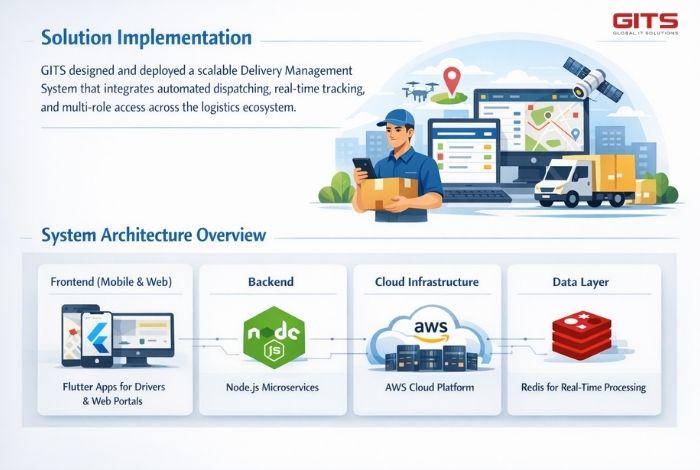
GITS designed and deployed a scalable Delivery Management System that integrates automated dispatching, real-time tracking, and multi-role access across the logistics ecosystem.
System Architecture Overview
The solution was built using a modular, cloud-native architecture:
– Frontend (Mobile & Web): Flutter-based mobile apps for drivers and responsive web portals for administrators and customers
– Backend: Node.js microservices architecture
– Cloud Infrastructure: AWS for scalability and reliability
– Data Layer: Redis for real-time data processing and caching
Key System Modules
1. Manufacturer & Admin Portal
– Create and manage delivery tasks
– Automate task assignment based on predefined rules
– Monitor delivery progress in real time
– Generate performance reports
2. Vendor Management Interface
– Track deliveries assigned to vendors
– Manage payments and delivery status
– Provide reporting tools for operational insights
3. Driver Mobile Application
– Receive and manage delivery tasks dynamically
– Access optimized delivery routes
– Collect proof of delivery (POD) from recipients
– Handle payment collection when required
4. Recipient Portal
– Track delivery status in real time
– Reschedule or modify delivery preferences
– Confirm receipt and provide feedback
Automated Dispatching Engine
At the core of the system is an intelligent dispatching engine that:
– Assigns delivery tasks based on location, availability, and workload
– Optimizes routes dynamically using real-time data
– Adjusts assignments based on traffic conditions and delivery priorities
Integration Approach
The system was integrated with the customer’s existing infrastructure:
– ERP systems for order data synchronization
– Vendor databases for delivery coordination
– Notification systems for real-time updates
This ensured a seamless transition without disrupting ongoing operations.
Measurable Results
The implementation of the Delivery Management System delivered significant improvements across operational and business metrics.
Operational Efficiency
– 35% reduction in manual dispatching workload
– 25% improvement in delivery assignment speed
Delivery Performance
– 20% reduction in average delivery time
– 30% increase in on-time delivery rate
Cost Optimization
– 18% reduction in fuel and route-related costs
– Lower dependency on additional workforce
Customer Experience
– Real-time tracking improved transparency
– Higher customer satisfaction due to accurate delivery updates
Scalability
– System supports multi-region expansion
– Easily handles increased delivery volume without performance degradation
>>> See More: Enhancing logistics efficiency with an advanced inventory management system
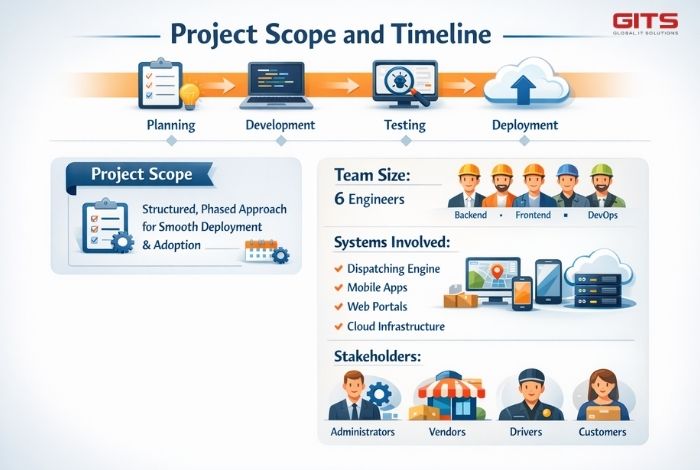
Project Scope and Timeline
The project was executed in a structured, phased approach to ensure smooth deployment and adoption.
Project Scope
– Team size: 6 engineers (backend, frontend, mobile, DevOps)
– Systems involved: dispatching engine, mobile apps, web portals, cloud infrastructure
– Stakeholders: administrators, vendors, drivers, customers
Timeline
Phase 1: Discovery & Design (3 weeks)
– Requirement analysis
– System architecture design
– UX/UI planning
Phase 2: Development (10 weeks)
– Backend and API development
– Mobile and web application development
– Integration with existing systems
Phase 3: Testing & Deployment (3 weeks)
– System testing and performance optimization
– User training and onboarding
– Production deployment
Phase 4: Post-Deployment Support (Ongoing)
– Monitoring and system optimization
– Feature enhancements based on feedback
Driving Scalable Logistics with a Modern Delivery Management System
This case study demonstrates how a well-designed Delivery Management System can transform last-mile logistics operations. By automating dispatching, enhancing real-time visibility, and optimizing routes, the customer achieved measurable improvements in efficiency, cost, and service quality.
GITS delivered not just a technology solution, but a scalable operational foundation that supports long-term growth and adaptability in a rapidly evolving logistics landscape.
Explore how GITS delivers scalable enterprise solutions tailored to your business needs.