






In today’s manufacturing and logistics landscape, inventory is no longer just about tracking stock. It has become a strategic asset that directly impacts production efficiency, customer satisfaction, and profitability.
Yet many businesses across Japan, Korea, Vietnam, and global markets still rely on spreadsheets, manual counting, or disconnected software to manage inventory. While these methods may work for small operations, they quickly become a bottleneck as businesses grow.
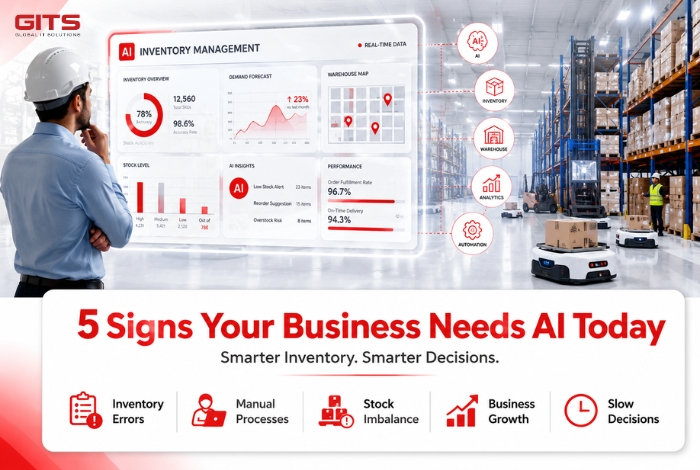
Modern Inventory Management powered by AI enables organizations to predict demand, automate decisions, optimize warehouse operations, and build a more resilient supply chain. If your business is experiencing any of the following warning signs, it may be time to rethink your inventory strategy.
Why Manual Inventory Management No Longer Supports Business Growth
Traditional inventory management focuses on recording what has already happened.
AI-powered Inventory Management goes much further. By combining real-time data, predictive analytics, AI Agents, and connected enterprise systems, businesses can anticipate inventory risks before they occur and automate routine decisions across the supply chain.
The shift is no longer from paper to software. It is from reactive inventory control to intelligent inventory optimization.
Inventory Errors Are Becoming a Daily Challenge
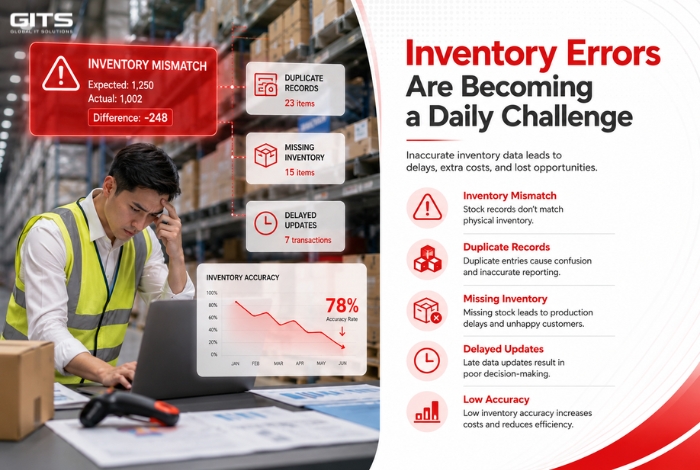
Frequent discrepancies between physical stock and system records are often the first sign that manual inventory management has reached its limits.
Common issues include:
– Missing inventory
– Duplicate stock records
– Incorrect inventory counts
– Delayed stock updates
These problems lead to production delays, order fulfillment issues, excess purchasing, and reduced customer trust.
An AI-powered Inventory Management solution automatically synchronizes inventory data across warehouses, ERP, WMS, and production systems, significantly improving inventory accuracy while reducing manual errors.
Your Team Spends More Time Updating Data Than Creating Value
If warehouse employees spend hours updating spreadsheets instead of managing operations, productivity suffers.
Manual inventory processes consume valuable time through stock counting, data reconciliation, and report preparation.
AI Inventory Management Automates Routine Work
Instead of relying on manual updates, AI-powered Technical Solutions combine barcode scanning, RFID, IoT sensors, and AI Services to deliver:
– Real-time inventory visibility
– Automated inventory updates
– Faster receiving and shipping
– Reduced administrative workload
– Improved workforce productivity
Employees can focus on operational improvement rather than repetitive data entry.
Stockouts and Overstock Continue to Increase
One of the biggest limitations of manual inventory management is that it only shows current inventory levels. It cannot predict future demand.
As a result, businesses often experience stock shortages for high-demand products while simultaneously carrying excessive slow-moving inventory.
Modern AI Solutions analyze demand patterns, seasonal fluctuations, supplier lead times, customer behavior, and market trends to forecast inventory requirements more accurately.
AI Agents can even recommend replenishment timing, identify obsolete inventory, and optimize safety stock before problems impact operations.
Your Business Has Outgrown Spreadsheets
As companies expand into multiple warehouses, factories, sales channels, or international markets, disconnected spreadsheets become increasingly difficult to manage.
Different departments often work with inconsistent inventory data, slowing decision-making and creating unnecessary operational risks.
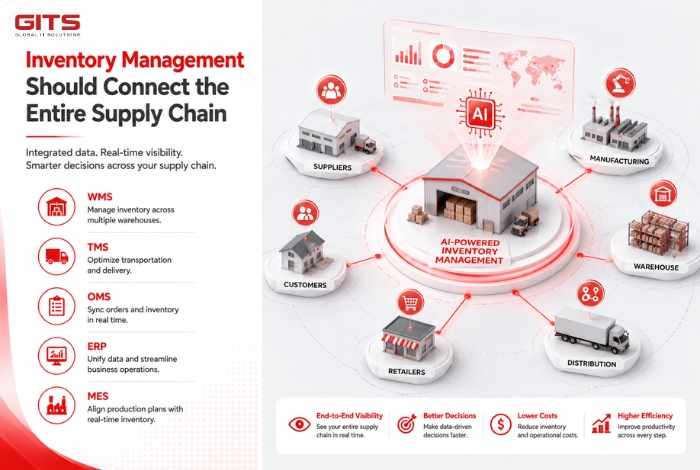
Inventory Management Should Connect the Entire Supply Chain
Modern Inventory Management integrates seamlessly with:
– Warehouse Management System (WMS)
– Transportation Management System (TMS)
– Order Management System (OMS)
– Enterprise Resource Planning (ERP)
– Manufacturing Execution System (MES)
This connected ecosystem provides a single source of truth that supports AI Logistics, Smart Manufacturing, and enterprise-wide AI Transformation (AX).
Business Decisions Depend on Historical Reports Instead of Real-Time Insights
If executives regularly ask questions such as:
– Which warehouse has available inventory?
– When will we run out of stock?
– Which products should be reordered first?
– How will next month’s demand affect inventory?
then your organization lacks the visibility needed for agile decision-making.
Unlike traditional software, AI-powered Inventory Management continuously analyzes operational data and delivers predictive recommendations rather than historical reports.
AI Agents can automatically:
– Detect potential stock shortages
– Recommend purchase orders
– Balance inventory across warehouses
– Alert managers to unusual inventory movements
– Forecast demand before disruptions occur
Instead of reacting to problems, businesses gain the ability to prevent them.
Manual Inventory vs AI-Powered Inventory Management
| Manual Inventory | AI-Powered Inventory Management |
|---|---|
| Spreadsheet-based | Real-time inventory visibility |
| Reactive decisions | Predictive recommendations |
| Manual stock counting | Automated inventory updates |
| Human-dependent processes | AI-assisted decision making |
| Limited reporting | Intelligent business insights |
| High risk of errors | Greater than 99% inventory accuracy potential |
Actual performance depends on implementation, operational maturity, and business environment.
Why AI Inventory Management Is Becoming a Competitive Advantage
Leading manufacturers and logistics providers are no longer investing in inventory software simply to improve visibility.
They are building intelligent supply chains where AI supports faster, smarter, and more autonomous operations.
The business benefits include:
– Higher inventory accuracy
– Lower operating costs
– Improved demand forecasting
– Faster order fulfillment
– Better warehouse productivity
– Stronger supply chain resilience
– Scalable digital operations
As AI Agents continue to evolve, Inventory Management is becoming a core component of Smart Factory, AI Logistics, and enterprise AI Transformation strategies.
>>> See More: AI Agents in Logistics: How Intelligent Automation Will Transform Supply Chains by 2030
Frequently Asked Questions
What is AI-powered Inventory Management?
AI-powered Inventory Management uses artificial intelligence, predictive analytics, and real-time operational data to optimize inventory decisions, automate routine tasks, and improve supply chain performance.
How do AI Agents improve inventory management?
AI Agents continuously monitor inventory data, predict shortages, recommend replenishment, detect anomalies, and automate repetitive decision-making, allowing businesses to respond faster and reduce operational risk.
Which industries benefit the most?
Manufacturing, logistics, retail, eCommerce, healthcare, automotive, and distribution businesses benefit significantly from AI-powered Inventory Management because they manage complex inventories across multiple locations.
Build Smarter Inventory for Long-Term Growth
Manual inventory management may be sufficient for small operations, but it quickly becomes a barrier to growth as supply chains become more complex. Frequent inventory errors, increasing administrative work, recurring stock issues, disconnected systems, and limited operational visibility all indicate that traditional methods are no longer enough.
AI-powered Inventory Management transforms inventory from a passive record-keeping function into an intelligent decision-making system. By combining AI Agents, predictive analytics, and integrated enterprise platforms, businesses can improve inventory accuracy, optimize warehouse operations, reduce costs, and build a resilient supply chain ready for the future of AI Logistics and Smart Manufacturing.