








For enterprises managing multiple distributors, warehouses, sales channels, and delivery points, distribution visibility is no longer simply an operational advantage. It is becoming a requirement for controlling cost, inventory, service quality, and customer experience.
Yet many distribution networks still rely on disconnected spreadsheets, manual reports, phone calls, emails, and fragmented enterprise systems. Headquarters may know how many products were shipped, but not always what is happening at distributor level. Inventory updates arrive late. Orders require manual verification. Delivery exceptions are discovered only after customers complain.
A Distribution Management System (DMS) addresses this visibility gap by connecting orders, inventory, distributors, sales activities, fulfillment, delivery, and performance data within a unified digital environment. Modern DMS platforms can provide a consistent view across channels, warehouses, and territories, helping management move from reactive control to data-driven distribution operations.
Why Distribution Visibility Is Becoming a Business Priority
As distribution networks expand across regions and countries, operational complexity increases rapidly.
A manufacturer may work with hundreds of distributors, thousands of retail outlets, and multiple logistics partners. Each participant generates data at different points of the distribution cycle. When these data flows are disconnected, management cannot easily identify where delays, stock shortages, order errors, or revenue leakage are occurring.
Common challenges include:
• Limited visibility into distributor-level inventory
• Delayed secondary sales information
• Manual order processing and reconciliation
• Inconsistent pricing and promotion execution
• Poor visibility into delivery status and exceptions
• Difficulty measuring distributor and territory performance
Research and current DMS solutions consistently emphasize real-time inventory, order, delivery, and channel visibility as core capabilities of modern distribution management platforms.
The result is a familiar problem: enterprises have plenty of data, but not enough usable visibility to make decisions quickly.

What Is a Distribution Management System?
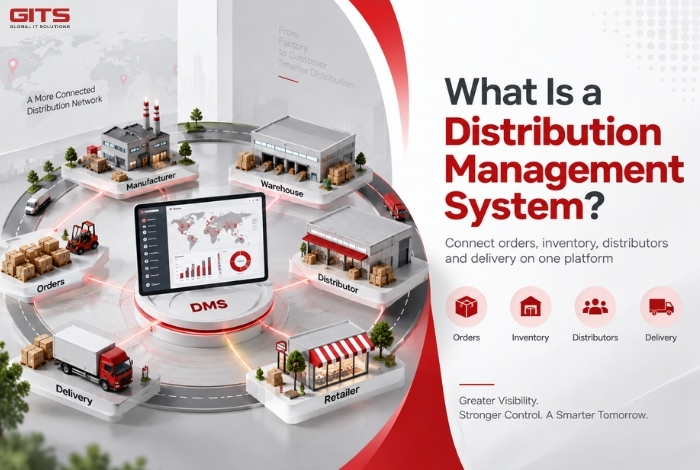
A Distribution Management System is an enterprise technology platform designed to manage and connect distribution operations from order capture through fulfillment, delivery, inventory movement, and channel performance.
Unlike a system that only records transactions, a modern DMS creates a connected operational layer across the distribution network.
Key capabilities typically include:
Centralized Order Management
Orders from distributors, dealers, sales teams, or digital channels can be captured and processed within one system. Automated validation, pricing rules, allocation, approval, and fulfillment workflows help reduce manual errors and accelerate order-to-delivery processes.
Real-Time Inventory Visibility
Instead of waiting for periodic reports, management can monitor inventory by warehouse, distributor, SKU, territory, or channel.
This makes it easier to identify slow-moving products, potential stockouts, inventory imbalances, and replenishment requirements before they affect customers.
Distributor and Channel Management
A DMS can centralize distributor profiles, sales performance, territories, pricing policies, promotions, credit conditions, and operational activities.
This creates a consistent source of information for sales, operations, finance, and management teams.
Delivery and Fulfillment Visibility
Connecting order information with fulfillment and delivery status enables teams to understand where an order is in the distribution process.
When integrated with WMS, TMS, ERP, or external logistics platforms, the system can provide broader end-to-end visibility from inventory allocation to final delivery.
How a Distribution Management System Improves Enterprise Control
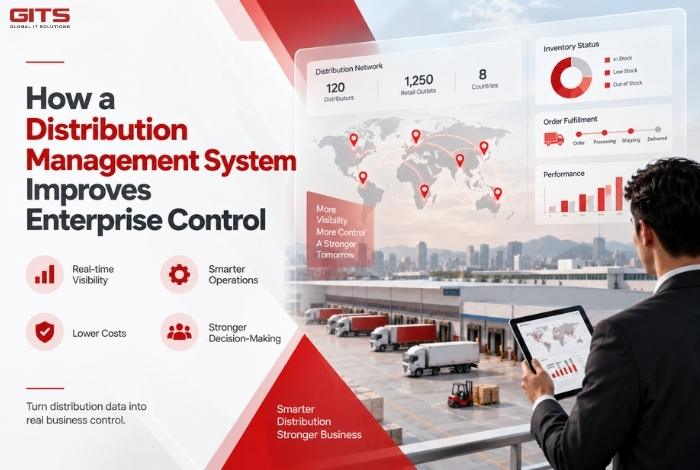
The biggest value of a DMS is not simply digitizing existing processes. It is creating a reliable operational data foundation for faster and more accurate decisions.
1. Replace Fragmented Data With One Source of Truth
When sales, inventory, orders, and delivery information exist across spreadsheets and independent systems, teams often work with different versions of reality.
A centralized DMS establishes a shared data environment across distributors, warehouses, sales teams, and management. This reduces reconciliation work and provides a consistent basis for operational decisions.
For enterprises operating across Japan, Korea, Vietnam, or multiple international markets, this centralized visibility becomes particularly valuable when distribution structures differ by region.
2. Detect Distribution Problems Earlier
Visibility becomes meaningful when it leads to action.
A DMS can identify low inventory, delayed orders, unusual sales patterns, delivery exceptions, or underperforming distributors through dashboards and alerts.
Instead of discovering a stockout after a retailer reports it, the enterprise can detect the risk earlier and initiate replenishment or allocation actions.
3. Improve Inventory and Working Capital Control
Inventory is one of the most important cost drivers in distribution.
Without accurate downstream visibility, enterprises may hold excessive safety stock in some locations while experiencing shortages in others.
By connecting inventory data across distribution nodes, a DMS supports more informed replenishment, stock allocation, and inventory planning. Some modern platforms also provide SKU-level visibility and automated replenishment signals.
From Distribution Management to AI-Powered Operations
The next evolution of distribution management is moving beyond dashboards toward intelligent decision support.
With AI Agents and Agentic AI, enterprises can build workflows that continuously monitor operational data, identify exceptions, and recommend or execute predefined actions.
For example, an AI-powered distribution workflow could:
• Detect unusual demand changes by territory
• Identify distributors at risk of stockout
• Recommend inventory redistribution
• Flag abnormal order patterns
• Prioritize delayed deliveries
• Generate operational summaries for management
This creates an important shift from simply seeing what happened to understanding what requires attention next.
Combined with AI Services, Technical Solutions, and enterprise AI infrastructure, these capabilities can become part of a broader AI Solution and AX (AI Transformation) strategy.

Where Document Management System Fits Into Distribution
Distribution operations generate a significant volume of documents, including purchase orders, invoices, delivery notes, contracts, claims, returns, and compliance records.
A Document Management System can complement a Distribution Management System by digitizing, organizing, retrieving, and controlling these documents.
The combination creates a more complete digital workflow: operational data determines what is happening, while document management ensures the supporting records are accessible, traceable, and controlled.
This is particularly useful for enterprises operating across multiple partners and markets where documentation, approvals, and auditability are essential.
>>> See More: Transportation Management System: Cut Costs & Gain Visibility
What Enterprises Should Look for in a Modern DMS
Choosing a Distribution Management System should go beyond checking the number of available modules.
Enterprises should evaluate whether the platform can connect their existing operational ecosystem and scale with business complexity.
Important capabilities include:
• Real-time order and inventory visibility
• Distributor and channel management
• Delivery and fulfillment tracking
• Dashboard and KPI analytics
• ERP, WMS, TMS, and API integration
• Mobile support for field operations
• Workflow automation and approval control
• AI-powered analytics and intelligent agents
• Security, access control, and audit trails
Modern DMS platforms increasingly position integration as a core capability, connecting ERP, WMS, TMS, finance, mobile sales, EDI, and APIs rather than operating as an isolated application.

Turn Distribution Visibility Into Operational Control
Distribution complexity cannot be solved by adding more spreadsheets or generating more periodic reports.
Enterprises need a connected technology foundation that brings together orders, inventory, distributors, fulfillment, delivery, documents, and performance data.
A Distribution Management System provides that foundation by transforming fragmented distribution information into real-time operational visibility. When combined with AI Agents, Agentic AI, AI Services, and intelligent automation, it can take distribution management further—from monitoring operations to proactively identifying risks and supporting faster decisions.
For enterprises in Japan, Korea, Vietnam, and global markets, the objective is not simply to digitize distribution. It is to build a distribution network that is visible, connected, intelligent, and controllable at scale.